Why Indonesia's Shampoo Market No Longer Has a Single Market Leader
Makarizo led e-commerce shampoo sales in April 2026 with an 8.8% share, while Pantene, the 2023 leader, is no longer in the top five.
E-commerce data shows competition growing more dispersed with rankings shifting, while consumer surveys still rate shampoo as a category with strong brand leadership, particularly through offline retail.
Makarizo's digital edge is linked to segmented stores, a broad portfolio, and bundling; a crowded FMCG market now requires brands to monitor performance and strategy on a channel-by-channel basis.

In the period of May 1–15, 2023, Pantene led shampoo market share in Indonesia's official e-commerce stores with 10.59%, followed by Head & Shoulders at 8.77% (Compas, 2023). Both belong to Procter & Gamble, and that ranking felt like common knowledge about the shampoo category.
Three years later, the picture looks different. Based on Compas data for April 2026, as reported by GoodStats (2026), Pantene is no longer in the top five. The market leader is now Makarizo, a brand owned by PT Akasha Wira International Tbk (ADES), listed on the Indonesia Stock Exchange, with a portfolio spanning everything from the mass market segment to professional salon needs.
This shift holds a more important question than simply who won. A single category can be read through two different measures at once, and each yields a different picture. Category-level consumer research still positions shampoo as a category with strong brand leadership. E-commerce sales data shows the top tier has already changed hands. In other words, the question "who leads the shampoo market" no longer has one correct answer.
This article traces how that split came about, why Makarizo's edge can't simply be copied by major players, and what it means for how brands read their own position.
Competition Spreading Across More Players
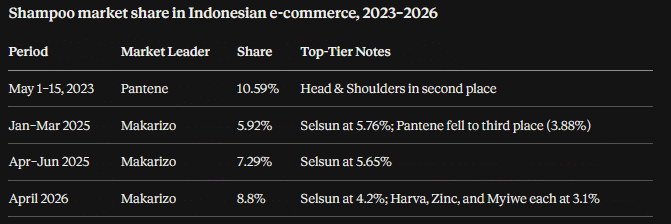
Shampoo market in Indonesia by Compas, from Databoks (2023) and GoodStats (2025a, 2025b, 2026). The change in the digital channel doesn't stop at a change of name at the top. What has changed is the structure of competition itself.
Citing Compas research reported by GoodStats (2025a, 2025b, 2026), the top ten shampoo brands in e-commerce throughout 2025 and into 2026 began to include names that had rarely entered mainstream conversation before. Myiwe broke into the top five in January–March 2025, while Cultusia and Lavojoy took sixth and seventh place in the same period. Zinc returned to the top ten in April–June 2025, and Harva and Zinc both broke into the top five in April 2026. Multinational brands remain on the list, but their positions have slipped and their shares have thinned.
The second indicator lies in the size of the leader's share itself. As reported by GoodStats (2025a, 2025b), Makarizo led with 5.92% in January–March 2025 and 7.29% in April–June 2025, then rose to 8.8% in April 2026 (GoodStats, 2026). All of these figures sit below the 10.59% Pantene held in 2023. Even so, a direct comparison needs to be read carefully, since the data collection methods for the two periods differ, as explained in the table notes.
This category hasn't simply changed leaders. Within periods using a consistent method, no single brand controlled more than 7.3% throughout 2025, and the composition of the top tier shifted from quarter to quarter.
Infographic with data sourced from Compas research, reported by Databoks and GoodStats over the 2023–2026 period. Source: Compas research, reported by Databoks (2023) and GoodStats (2025a, 2025b, 2026).
Data collection methods differ across periods, so the figures in this table cannot be compared directly. The May 1–15, 2023 data covers only official stores on Shopee and Tokopedia, filtered by top brand, period, merchant, subcategory, and seller type. The 2025-period data covers both official and unofficial stores on Shopee alone, filtered to products rated at least four stars. GoodStats did not publish the platform coverage or method used for the April 2026 period. Including unofficial stores enlarges the denominator, which may have lowered brand shares in the 2025-period figures.
When E-Commerce and Offline Retail Tell Different Stories
Compas's findings aren't the only way to read the shampoo market. Consumer surveys, in fact, paint a different picture.
As reported by Jakpat (2026), the Beauty Trends Report 2025 #3, which surveyed 2,096 respondents across Indonesia via the Jakpat mobile app, positions shampoo as an example of a category with strong brand leadership — distinct from categories like fragrance, which are far more fragmented and where preferences are highly personal.
The same research explains why. According to Jakpat (2026), consumer awareness of personal care products is still largely driven by traditional media, particularly television, with paid digital channels and retail touchpoints playing a supporting role. Hybrid retail behavior also persists: offline retail remains dominant, while marketplace relevance keeps growing, especially through Shopee and TikTok Shop.
These two findings don't cancel each other out. Jakpat measures perception and brand structure at the category level, while Compas measures sales share within a single channel. Jakpat does not specify which brands lead, nor does it separate brand structure between offline retail and e-commerce channels. The reading below is our own analysis drawing on both findings.
This difference arises because the way consumers discover and buy products in offline retail differs from the way they do so in a marketplace. On a minimarket shelf, space is limited and contested through trade negotiations, and consumers choose from options the retailer has already curated and made known through television advertising. In a marketplace, the number of products that can be displayed isn't constrained by physical space, and a small brand can appear in the very same search results as a giant one. Compas (2025) identifies search-engine optimization for product discovery on e-commerce as one of the key strategies in this channel — a sign that the path to online product discovery doesn't rest entirely on brand name recognition.
It's this difference in mechanics that helps explain why Compas's and Jakpat's results can both be correct at the same time.
Why Makarizo Wins Online
Back to the question left hanging at the start. Compas links Makarizo's rise to three structural decisions, all of which can only be executed in the digital channel, separate from factors like brand popularity or product benefit claims.
According to Compas's analysis as reported by GoodStats (2026), the first factor is a segmented direct-to-consumer architecture. Rather than folding its entire product line into a single official store the way most FMCG companies do, Makarizo has built separate sales ecosystems organized around its product pillars. The second factor is a portfolio spanning the mass market, clinical treatment, and professional salon segments, allowing the brand to address a wide range of hair concerns without relying on a single claim. The third factor is bundling, with 28.05% of Makarizo's sales share coming from products sold in bundled packages.
This is the part that's easy to miss: none of these three advantages has an equivalent on a store shelf. A segmented store setup is simply impossible in a minimarket where shelf space is rationed. A portfolio that extensive would never fit entirely onto a single shelf. Bundled packages compete against the logic of modern retail, which sells by the unit.
The consequence is that big players can't win the digital channel simply by transplanting their offline structure onto it. What's required is rebuilding the sales architecture for an arena that plays by different rules — and that's organizational work, not campaign work.
The scale of that arena makes the task hard to postpone. According to Compas (2025), beauty products accounted for half of total FMCG sales in Indonesian e-commerce throughout the first half of 2025, growing 28% year-on-year.
As Competition Tightens, How We Read the Market Has to Change
This channel split is happening at the same time competition across the broader FMCG market is also intensifying.
As reported by Antara (2026), the Brand Footprint 2026 report from Worldpanel by Numerator, presented on July 15, 2026, recorded that the number of brands covered in the report grew from 436 to 451. Yet a growing number of players hasn't come with a growing number of brands actually growing. The share of brands recording growth actually fell from 62% to 44% in 2025, even as household shopping habits remained relatively stable. Worldpanel Indonesia Managing Director Venu Madhav stated that consumers are still shopping regularly, but brands can no longer rely on market growth alone.
Amid this increasingly crowded competition, the brands that are growing also share a similar pattern. As reported by Liputan6 (2026), 80% of growing brands succeeded in increasing household penetration, either on its own or alongside an increase in purchase frequency. However, increasing household penetration isn't always easy in the shampoo category. As an everyday-necessity product with already-high penetration — though up-to-date penetration figures for Indonesia are not yet publicly available — the room to recruit new users is relatively limited. Under these conditions, growth is more likely to come from winning over buyers of other brands, pushing consumers up to a higher price tier, or increasing purchase volume per transaction.
Makarizo's performance shows how a bundling strategy can be one way to increase transaction value in an already-mature category. At the same time, the entry of Harva, Zinc, Myiwe, and Cultusia into the top tier shows that the battle for consumers between brands is also very much underway.
A Note on Market Size
One thing that still lacks a clear picture is the overall value of Indonesia's shampoo market as a whole. To date, the available data mostly shows performance within a specific channel or the movement of individual brands, which isn't sufficient to describe how large this category is in aggregate. Expert Market Research (2026) puts Indonesia's shampoo market at roughly USD 550 million in 2025, with a projected CAGR of 3.70% from 2026 through 2035. IndexBox (2025), by contrast, recorded the market falling 5.3% to USD 556 million in 2024, after peaking at USD 689 million in 2019.
The two figures can't be compared directly. IndexBox calculates market size as apparent consumption — production plus imports minus exports — and states its value in nominal wholesale prices, meaning retailer margins are not included. Expert Market Research does not disclose its calculation basis. The result is that one source's 2025 figure actually sits below another source's 2024 figure, with the trend direction pointing in opposite ways.
This discrepancy makes market size difficult to use as a sole anchor for reading the category's direction. When commercial research providers themselves don't agree on whether the market is growing or shrinking, directly observable behavioral indicators become a safer footing: sales share by channel, purchase frequency, and brand position shifts from one period to the next.
Implications for Brands
Don't just monitor market share in aggregate. A brand's performance can look stable overall even as it starts losing ground in a specific channel. Monitoring performance channel by channel helps a brand detect change earlier, before a decline spreads to the wider market.
Build a distinct strategy for each channel. An edge in physical stores doesn't automatically translate into the same performance in a marketplace. Each channel has its own way consumers discover, compare, and choose products. Distribution, promotion, and content strategy all need to be adapted to the characteristics of each channel.
In mature categories, focus on retention and consumer switching. When market penetration is already high, growth opportunities are more likely to come from winning over other brands' consumers or retaining existing customers. That makes product differentiation, the shopping experience, and the reasons to keep choosing a brand increasingly important.
Closing
The shampoo category is often treated as a settled market, dominated by a handful of big names and moving slowly. Data from the past three years tells a different story — but only when viewed through the right channel.
What has changed is the arena in which the product is being contested, while the product itself has stayed the same. And when a single category operates across two arenas with different rules, a brand ranking stops being able to explain its position on its own.
Brands have long asked who leads the market. The more useful question now is: leads where?
References
Antara. (2026, July 16). Worldpanel: Strategi gaet pembeli baru kunci menangkan pasar FMCG. Retrieved August 3, 2026, from https://megapolitan.antaranews.com/berita/540500/worldpanel-strategi-gaet-pembeli-baru-kunci-menangkan-pasar-fmcg
Compas. (2025, September 18). Mengulas performa e-commerce Indonesia Semester 1 2025: Strategi kunci untuk brand FMCG. Retrieved August 3, 2026, from https://compas.co.id/article/mengulas-performa-e-commerce-indonesia/
Databoks. (2023, August 28). 5 merek sampo dengan pangsa pasar terbesar di e-commerce, Pantene juaranya. Retrieved August 3, 2026, from https://databoks.katadata.co.id/teknologi-telekomunikasi/statistik/47c3aec34607b37/5-merek-sampo-dengan-pangsa-pasar-terbesar-di-e-commerce-pantene-juaranya
Expert Market Research. (2026). Indonesia shampoo market size, share & growth trends 2035. Retrieved August 3, 2026, from https://www.expertmarketresearch.com/reports/indonesia-shampoo-market
GoodStats. (2025a, September 11). 10 brand shampoo terlaris di Shopee Indonesia 2025, mana favoritmu? Retrieved August 3, 2026, from https://data.goodstats.id/statistic/10-brand-shampoo-terlaris-di-shopee-indonesia-2025-mana-favoritmu-TFMuC
GoodStats. (2025b, November 25). 10 brand shampoo terlaris di Shopee Indonesia Q2 2025, mana favoritmu? Retrieved August 3, 2026, from https://data.goodstats.id/statistic/10-brand-shampoo-terlaris-di-shopee-indonesia-q2-2025-mana-favoritmu-d3HAz
GoodStats. (2026, June 8). 5 brand shampoo terlaris di e-commerce April 2026, mana favoritmu? Retrieved August 3, 2026, from https://data.goodstats.id/statistic/5-brand-shampoo-terlaris-di-e-commerce-april-2026-mana-favoritmu-1IXGo
IndexBox. (2025). Indonesia's shampoo market report 2025: Prices, size, forecast, and companies. Retrieved August 3, 2026, from https://www.indexbox.io/store/indonesia-shampoos-market-analysis-forecast-size-trends-and-insights/
Jakpat. (2026, May 22). Body & hair care trends & usage behavior: Jakpat beauty trends report 2025 #3. Jakpat Insight. Retrieved August 3, 2026, from https://insight.jakpat.net/body-hair-care-trends-usage-behavior-jakpat-beauty-trends-report-2025-3/
Liputan6. (2026, July 16). Pasar barang sehari-hari kian ketat, gaet pembeli baru kunci pertumbuhan. Retrieved August 3, 2026, from https://www.liputan6.com/bisnis/read/8247060/pasar-barang-sehari-hari-kian-ketat-gaet-pembeli-baru-kunci-pertumbuhan