- Does this campaign or content create a sense of inadequacy in women before offering a solution?
- Does this present only one definition of beauty, or one life choice treated as the ideal?
- Does the woman in this content have agency, or does she function merely as a visual object or an object within a power dynamic?
- Is this brand's message of support or empowerment backed by concrete action?
- If this content is publicly debated, is the brand ready to explain the editorial reasoning behind it?
Beauty Campaigns Are Now Serious Discourse: Implications for Brands
Intinya Sih
Indonesia's beauty market keeps growing. Babel Insight (2026) recorded the market's value at US$9.74 billion in 2025, targeted to surpass US$10 billion in 2026.
Consumers no longer evaluate just the product, but also a brand's communication decisions — from influencer selection and campaign representation to UGC curation and response.
Terms like male gaze and choice feminism are increasingly used as lenses for reading campaigns, meaning a single message can be interpreted differently by different audience groups.
Indonesian women consumers are increasingly diverse — in purchasing power, preferences, and brand loyalty alike — so no single marketing narrative can be assumed relevant to every segment.
Brands therefore need a consistent internal process for evaluating campaigns and UGC, both before and after publication.
This section summary was AI-assisted and reviewed by our editorial team.
In recent times, beauty brand campaigns are no longer judged solely on creativity or product quality. How a brand chooses its stories, responds to public conversation, and represents women in its campaigns has become fodder for discussion on social media.
One illustration can be seen in the following composite scenario. A beauty brand runs a dedicated account for reposting user-generated content (UGC). One day, the account reposted the story of a young woman who married a man 43 years her senior, then gave a response that the public perceived as an endorsement of that story.
Online conversation split down the middle. Some saw it as simply an ad and a personal choice, while others questioned the power dynamics behind the story. The debate kept rolling until the product being promoted was drowned out entirely by arguments over power dynamics, the representation of women, and the meaning of the campaign itself.
This composite scenario shows that audiences today evaluate not only the product a beauty brand sells, but also the communication decisions behind its campaign. Influencer selection, representation in advertising, UGC curation, and how a brand responds to public conversation are increasingly seen as a reflection of the values a brand holds. In other words, communication decisions have become part of a brand's identity, and the public judges them accordingly.
Debate over the representation of women in advertising and marketing campaigns isn't actually new. But the growth of social media has sped up the spread of that conversation and widened its reach. In Indonesia, the Digital 2025: Indonesia report shows internet users are active on an average of around seven social media platforms every month. This means a campaign is no longer judged only by the audience a brand planned to target, but is also interpreted and debated by a much wider public.
It's this shift in how consumers read marketing messages that presents a new challenge for players in the beauty industry.
This article examines how shifts in the way the public interprets campaigns affect brand communication strategy. The focus isn't on determining whether any feminist theory or brand communication decision is right or wrong, but on how various interpretive frameworks — such as the male gaze or choice feminism — are used by the public to read campaigns, and what that means for brand communication strategy.
Table of Content
The Product No Longer Stands Alone: Narrative and Brand Reactions Are Judged Too
Indonesia's beauty market is in a strong position. According to Babel Insight (2026), citing the Ministry of Industry, the national cosmetics market's value reached US$9.74 billion in 2025, with annual growth of around 4.33% to 4.37%, and is targeted to surpass US$10 billion in 2026. Statista Market Insights (2026) reinforces this picture with a revenue projection for Indonesia's Beauty & Personal Care market of US$10.55 billion in 2026 and a compound annual growth rate (CAGR) of 5.52% for the 2026–2031 period.
This category's resilience shows even when purchasing power weakens. Babel Insight (2026), citing Celios Digital Economy Director Nailul Huda, links that resilience to the lipstick effect — consumers' tendency to keep buying beauty products for personal satisfaction even when finances are tight.
The sheer size of the beauty market doesn't just expand business opportunity — it also raises consumer expectations about how brands communicate. On social media, a product is no longer judged separately from the narrative accompanying it. Influencer choices, the representation of women in advertising, campaign messaging, and decisions about which user-generated content to feature or respond to can all be read as a reflection of a brand's values.
In this context, every communication decision is also an editorial decision — not in the sense of choosing which news to publish, but in determining which stories deserve to be featured, whose voice gets a platform, which message gets amplified, and how the brand responds to public conversation. Consumers, therefore, aren't just evaluating product quality; they're also interpreting the values they see behind each of those communication decisions.
Why Do Consumers Read Campaigns Differently?
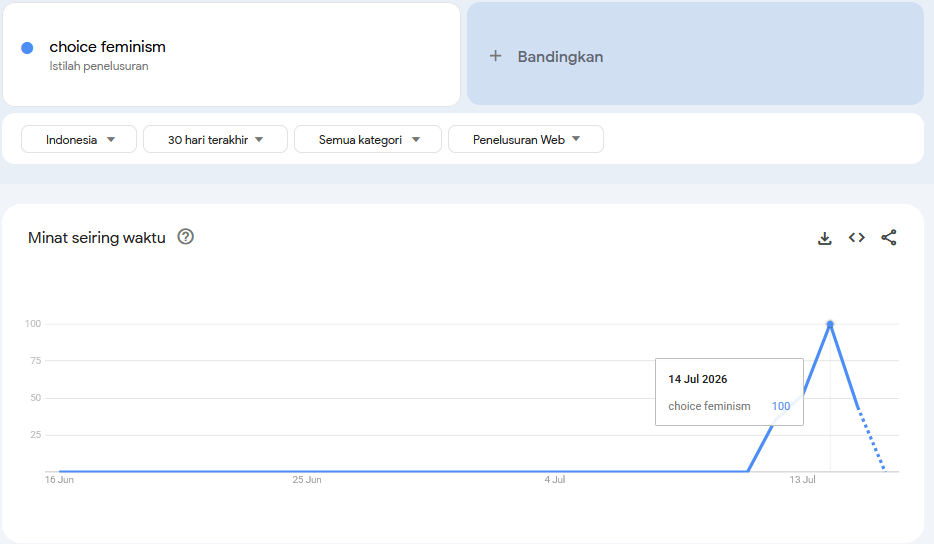
Hasil pencarian GoogLe Trends Indonesia mengenai choice feminisim (16/07/26) Over the past few years, terms like male gaze, pick me, and choice feminism have surfaced more and more often as frameworks the public uses to read campaigns. These terms help put a name to certain patterns while also showing that the very same message can be interpreted differently by different audiences.
One term that's increasingly talked about is choice feminism. It was first introduced by Linda Hirshman in her book Get to Work: A Manifesto for Women of the World (2006). Over time, the concept has often been used to question whether choices that appear to be entirely personal — such as the representation of women in advertising, empowerment narratives in campaigns, or a preference for a particular gender role — genuinely arise from individual will, or are also shaped by social norms and power dynamics that had already formed those preferences beforehand.
In the context of the beauty industry, this framework can be used to read how the public interprets a "woman's choice" narrative in a campaign. Some audiences may see it as a form of individual agency, while others question whether the campaign is, in fact, reproducing beauty standards, power dynamics, or gender expectations that have long existed in society.
In Indonesia, discourse around choice feminism has also begun to surface outside academic spaces. Outlets like Magdalene have covered it in a number of articles. Meanwhile, Google Trends shows that search interest in the term choice feminism in Indonesia hit its highest index in mid-July 2026. Although this data doesn't reflect absolute search volume, the spike indicates growing public attention to a term that previously appeared mostly in academic and media discussions.
Regardless of which framework is used, the emergence of these terms shows that consumers are increasingly active in questioning how the industry helps shape women's preferences, standards, and choices.
The Brand Challenge Lies in How the Public Interprets the Message
Social media accelerates the spread of terms and frameworks that help the public read a phenomenon, from male gaze, girlboss, and pick me to internalized misogyny and choice feminism. These terms help the public put a name to patterns that were previously hard to explain, while also making the discussion more accessible to the wider public.
On the other hand, social media algorithms tend to incentivize interpretations that are quick, concise, and easy to share. But the rhythm of social media also tends to push toward oversimplification. As a result, a campaign can become known first through a single label, before the public understands its context, creative process, or communication goals.
In a situation like this, a brand's main challenge isn't merely facing criticism, but understanding how its message could potentially be read by various audience groups. Avoiding every piece of criticism isn't a realistic goal. What matters more is making sure every communication decision stays aligned with the values the brand wants to build.
Women Consumers Are Growing More Diverse
Indonesia's beauty market isn't just large — it's also underpinned by a highly diverse base of women consumers. Statistics Indonesia (BPS) (2026) recorded more than 109.6 million female residents aged 15 and above in Indonesia. But the sheer size of this population doesn't mean their preferences, values, or how they interpret beauty are homogeneous.
This fragmentation shows up in purchasing power. Macromill South East Asia (2025) found that the majority of consumers spend between Rp250,001 and Rp5,000,000 per month on the beauty and wellness category, based on a survey of 420 respondents in DKI Jakarta and Greater Jakarta (Jabodetabek). This finding shows that the beauty market spans consumers with widely varying purchasing power and consumption patterns.
Fragmentation also shows up in brand loyalty. The absence of any single dominant brand indicates that consumer preferences are increasingly fragmented. Brands no longer compete within one mainstream current, but across a range of distinct need- and value-based niches. Sociolla marketplace data reported by Zweena (2025) shows no single player dominates. Skintific leads with a 7% share, followed by MS Glow (6.9%) and Wardah (2.97%). Newer entrants like Glad2Glow have even managed to enter the rankings with a 2.51% share.
Social media has also become a space where the definition of beauty is continually debated and negotiated. A study by Wilmanda and Hariyanti (2025) in Kanal: Jurnal Ilmu Komunikasi found that the TikTok account @cadburylemonade presents a representation of beauty that departs from the dominant standard and received a positive response from its audience. This finding indicates that some social media users are beginning to make room for a more diverse definition of beauty.
For brands, this means there's no longer a single marketing narrative that can be assumed relevant to all Indonesian women. The more diverse the ways consumers interpret beauty, the more important it becomes for brands to understand exactly who they want to speak to and what values they want to represent.
Implications for Beauty Brands
The shift in how consumers interpret campaigns demands a shift in how brands manage communication. In the social media era, the communication challenge no longer stops at the quality of the message a brand wants to convey — it also extends to how that message will be interpreted by the public.
This means more and more communication decisions need to be treated as editorial decisions. Influencer selection, UGC curation, representation in campaign materials, and responses to public conversation are no longer just marketing activities — they're part of the process of building and maintaining brand values.
That's why the curation process can't rely solely on individual judgment or spontaneous decisions. Brands need clear internal guidelines on what values they want to represent, who has the authority to make decisions, and how to evaluate public response once a campaign is live.
This approach matters even more given that consumers increasingly weigh the values a brand carries. The ZAP Beauty Index 2024 found that 84% of Indonesian women are willing to pay more for environmentally friendly products. In other words, when a brand consistently demonstrates a particular value, that value doesn't just shape its image — it can also become a factor in purchase decisions.
The reach of this discussion also shouldn't be underestimated. DataReportal, as cited by Kompas (2025), recorded around 180 million social media users in Indonesia at the end of 2025. The Digital 2025: Indonesia report shows that 46% of social media user identities are women, while APJII (2025) recorded women making up 49% of the national internet-user base. With a digital audience this large, the way the public interprets a campaign has the potential to shape brand perception at scale.
In a fast-moving communication environment, being slow to pick up on shifts in public sentiment can heighten reputational risk. That's why monitoring digital conversation no longer functions merely as a campaign-evaluation tool, but also as part of communication risk management.
Ultimately, a brand's goal isn't to make sure everyone agrees with its campaign — that's nearly impossible. What's more realistic is ensuring that every communication decision springs from a clear set of values, is applied consistently, and can be defended when the public asks questions.
Five Questions Before Launching a Campaign or Reposting UGC
This five-question framework applies across issues — from body positivity and shade-range selection to hijab representation, age-related issues, AI use, and influencer selection.
Closing
In the social media era, brands are no longer the sole party shaping the meaning of a campaign. The public also interprets, criticizes, and even labels the messages a brand puts out. That's why competitive advantage is no longer determined solely by product quality or campaign creativity, but also by a brand's ability to understand how every communication decision will be read by an increasingly diverse audience.
In the end, the challenge isn't making sure everyone agrees with a brand's message, but making sure that message springs from a clear set of values, is carried out consistently, and can be defended when the public asks questions.
References
Google Trends. (2026). Choice feminism [Data tren penelusuran]. Retrieved July 16, 2026, from https://trends.google.com/trends/explore?q=choice%20feminism&geo=ID
Hettinger, D. (2026, May 11). Industri kosmetik nasional targetkan pasar US$10 miliar pada 2026. Babel Insight. Retrieved July 16, 2026, from https://www.babelinsight.id/target-pasar-industri-kosmetik-nasional-2026
Hettinger, D. (2026, May 11). Industri skincare nasional diprediksi tumbuh stabil pada 2026. Babel Insight. Retrieved July 16, 2026, from https://www.babelinsight.id/pertumbuhan-industri-skincare-indonesia-2026
Hirshman, L. R. (2006). Get to work: A manifesto for women of the world. Viking.
Kompas.com. (2025, November 29). Segini jumlah pengguna media sosial di Indonesia saat ini. Retrieved July 16, 2026, from https://tekno.kompas.com/read/2025/11/29/19000027/segini-jumlah-pengguna-media-sosial-di-indonesia-saat-ini
Macromill South East Asia. (2025, October 3). Membuka tren terbaru pasar kecantikan & kesehatan Indonesia 2025. Retrieved July 16, 2026, from https://www.macromillsea.com/Indonesia-beauty-wellness-report-2025
Magdalene. (2015). Feminism is about choice, right? Not quite. Retrieved July 16, 2026, from https://magdalene.co/story/feminism-is-about-choice-right-not-quite/
Magdalene. (2019). I made a choice! Am I feminist enough? Retrieved July 16, 2026, from https://magdalene.co/story/choice-feminism-and-why-its-not-enough/
Nose Herbal Indo. (2025, April 16). Bisnis kecantikan makin meningkat! Intip produk yang punya peluang besar! Nose. Retrieved July 16, 2026, from https://nose.co.id/bisnis-kecantikan-makin-meningkat-intip-produk-yang-punya-peluang-besar
Statista. (2026). Beauty & Personal Care – Indonesia [Market forecast]. Statista Market Insights. Retrieved July 16, 2026, from https://www.statista.com/outlook/cmo/beauty-personal-care/indonesia/
Untari, P. H. (2025, August 6). Data APJII: Pengguna internet di Indonesia tembus 229,43 juta orang pada 2025. Bisnis.com. Retrieved July 16, 2026, from https://teknologi.bisnis.com/read/20250806/101/1899997/data-apjii-pengguna-internet-di-indonesia-tembus-22943-juta-orang-pada-2025
Vancouver Rape Relief & Women's Shelter. (n.d.). Redefining empowerment: The case against choice feminism. Retrieved July 16, 2026, from https://rapereliefshelter.bc.ca/redefining-empowerment-the-case-against-choice-feminism/
Wikipedia. (2025). Choice feminism. Retrieved July 16, 2026, from https://en.wikipedia.org/wiki/Choice_feminism
Wilmanda, G., & Hariyanti, N. (2025). Shifting Indonesian beauty standards on TikTok @cadburylemonade: A critical discourse analysis study. Kanal: Jurnal Ilmu Komunikasi, 13(2), 75–89. https://doi.org/10.21070/kanal.v13i2.1832
ZAP Clinic. (2024). ZAP Beauty Index 2024. Retrieved July 16, 2026, from https://zapclinic.com/files/ZAP_Beauty_Index_2024.pdf
Zweena Adi Nugraha. (2025, December 27). Skincare & kosmetik Indonesia 2025: Petualangan 12 bulan yang gila-gilaan. Zweena. Retrieved July 16, 2026, from https://zweena.co.id/artikel/skincare-kosmetik-indonesia-2025-petualangan-12-bulan-yang-gila