Reading the Pattern Behind Surabaya's Offline Activities

Offline activities in Surabaya draw attendance not only because of their main function, but also because of added benefits such as recreation, productivity, transactions, knowledge, and networking.
Races, warkop (coffee stalls), business events, festivals, matchdays, and communities all point to two main kinds of value: practical benefit and social experience in the form of identity, community, and togetherness.
This varied data is not proof of cause and effect, nor is it a measure of overall public interest; for brands, the focus should be understanding why an audience shows up and adding value that's relevant to that reason.
Offline activity in Surabaya shows an interesting pattern. Data from Statistics Indonesia (BPS) shows that only 30.60% of East Java's population exercised regularly in 2024. Yet ISOPLUS Run Series 2026 is targeting 9,000 participants in Surabaya, higher than Jakarta's target of 8,000. Surabaya is also the only city in the series to offer both a Half Marathon and a Full Marathon category (BPS, 2024; Jurnal Post, 2026; Wanita Indonesia News, 2026).
These two figures can't really be compared directly. Regular sports participation measures a habit, while a race's participant target measures an agenda's ability to gather people at a single point in time. But the contrast is worth noting: a person doesn't have to exercise regularly to have a reason to join a race once that activity is packaged as an event.
Showing up in person always requires something: time, energy, attention, and in many cases, money. That's why people have a specific reason when they decide an activity is worth attending.
This becomes clear when the various offline activities in Surabaya are read side by side. Races, warkop, business events, festivals, football matches, and running communities each offer a different core activity. But people's presence there doesn't stop at that main activity. There's a benefit they can take home, someone they can meet, a sense of community they can feel, or simply an experience that feels more appealing when done together with others.
For brands, this changes the question slightly. It's not just "how many people showed up?" but "what made them want to show up?"
Offline activities in Surabaya draw attendance not only because of their main function, but also because of added benefits such as recreation, productivity, transactions, knowledge, and networking.
Races, warkop (coffee stalls), business events, festivals, matchdays, and communities all point to two main kinds of value: practical benefit and social experience in the form of identity, community, and togetherness.
This varied data is not proof of cause and effect, nor is it a measure of overall public interest; for brands, the focus should be understanding why an audience shows up and adding value that's relevant to that reason.
Offline activity in Surabaya shows an interesting pattern. Data from Statistics Indonesia (BPS) shows that only 30.60% of East Java's population exercised regularly in 2024. Yet ISOPLUS Run Series 2026 is targeting 9,000 participants in Surabaya, higher than Jakarta's target of 8,000. Surabaya is also the only city in the series to offer both a Half Marathon and a Full Marathon category (BPS, 2024; Jurnal Post, 2026; Wanita Indonesia News, 2026).
These two figures can't really be compared directly. Regular sports participation measures a habit, while a race's participant target measures an agenda's ability to gather people at a single point in time. But the contrast is worth noting: a person doesn't have to exercise regularly to have a reason to join a race once that activity is packaged as an event.
Showing up in person always requires something: time, energy, attention, and in many cases, money. That's why people have a specific reason when they decide an activity is worth attending.
This becomes clear when the various offline activities in Surabaya are read side by side. Races, warkop, business events, festivals, football matches, and running communities each offer a different core activity. But people's presence there doesn't stop at that main activity. There's a benefit they can take home, someone they can meet, a sense of community they can feel, or simply an experience that feels more appealing when done together with others.
For brands, this changes the question slightly. It's not just "how many people showed up?" but "what made them want to show up?"
From Activity to Reason for Attending
Sports offer one entry point for reading this pattern.
In recent years, sports and sport events have grown into part of the lifestyle in many cities. Physical activity now comes bundled with health, fitness, recreation, identity, and how people present themselves. The community infrastructure around it has grown too. According to Strava data, running clubs in Indonesia grew sixfold throughout 2025, with the number of active runners rising from 56,000 in January 2024 to 242,000 in May 2025 (GoodStats, 2026). Over the same period, the 2025 national running calendar recorded more than 600 events (Indonesia Marathon, 2025).
Still, this data isn't enough to conclude that the growth in races is driven purely by an increase in exercise habits. In Surabaya's case, there's actually a contrast between the level of regular sports participation in East Java and the scale of the race targets set for the city.
That's why a race is more interesting to read as an example of sport not always showing up as a routine habit. It can also show up as an event.
A person doesn't need to make exercise part of their daily routine to have a reason to join a race. On a single occasion, a race can function as exercise, recreation, a place to meet a community, and a shared experience all at once. What a participant is after, then, isn't necessarily just the physical activity.
The question becomes simpler: what makes a race interesting enough to attend?
The same question can be brought to other offline activities that are closer to everyday life. If a race brings together sport, recreation, and community, does the same pattern show up in more everyday offline spaces?
When a Gathering Place Also Becomes a Productive Space
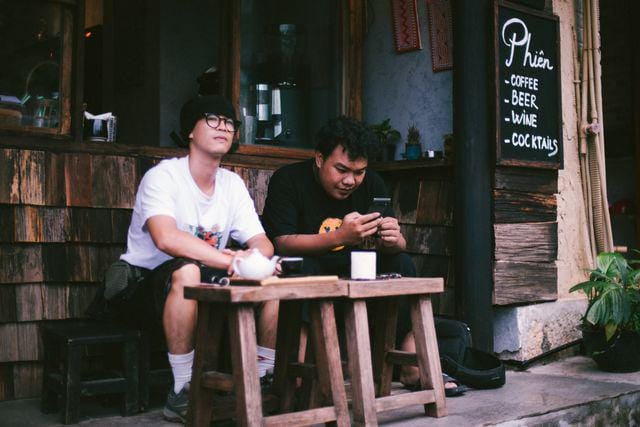
Surabaya has 12,510 coffee stalls, the highest number nationally, equal to 2.7% of the roughly 461,000 stalls across Indonesia. Sidoarjo also has more than 10,000 coffee stalls (GoodStats, 2026). This figure comes from point-of-interest (POI) data that includes traditional coffee stalls, so it shouldn't be read as a census of trendy modern coffee shops. Even so, the number still gives a picture of how much space is available for coffee-based activity in Surabaya.
Employment context adds another layer for reading what these spaces are used for. In East Java, 38% of the population is self-employed (Jakpat, Survey 53718, n=305, fieldwork June 2026). Meanwhile in Surabaya, 14% of respondents own a business and 43% are employees or staff (Jakpat, Survey 52845, n=505, fieldwork April 2026).
Combining this data opens up the possibility that warkop serve a wider function than simply a place to buy a drink. For the self-employed, a coffee stall can become a place to meet clients without having to rent a dedicated space. For employees, the same place can become a space to continue working after office hours.
In other words, a single place can meet several needs at once. People come to have coffee, but they can also work, meet people, or discuss business at the same time.
This is where the function of a space becomes important for brands. A brand doesn't always need to create a new activity to make a place relevant. Sometimes the opportunity actually lies in the activity that's already happening there. If people are already showing up to work, meet, or gather, a brand simply needs to find a way to add value without disrupting the original reason they came.
When an Event Combines Several Kinds of Value
The same pattern shows up in agendas that were designed from the start to bring people together. In January 2026, the Surabaya City Government together with HIPMI East Java held Founders Bootcamp at Balai Pemuda, a program that prepares aspiring founders before they build a business. A few months later, Rise to IPO Surabaya 2026 selected 60 medium-sized businesses through a collaboration between the Ministry of MSMEs, the Indonesia Stock Exchange, and Bank Mandiri (Pemerintah Kota Surabaya, 2026a; Kementerian UMKM, 2026).
Both agendas have a fairly clear reason for attendance. People come to gain knowledge, but showing up in person also opens the chance to meet people relevant to their business. A single agenda can end up producing several benefits at once: knowledge, networking, and even possible access to funding.
Something different in form happens with cultural and entertainment events. Festival Rujak Uleg on 9 May 2026 and Surabaya Vaganza both gave space for small and medium businesses to showcase and sell their products. Visitors came to enjoy the event, while at the same location, transactions, product introductions, and interactions with business owners were taking place (Pemerintah Kota Surabaya, 2026b).
These examples show that people can have more than one reason to attend an activity. The more relevant the added benefit, the easier it is for an activity to offer something beyond its main function.
This doesn't mean every event should be packed with as many activities as possible. Quite the opposite: those additions are only useful if they actually connect to the reason people came in the first place.
But Practical Benefit Isn't Everything
Not every activity capable of gathering a crowd offers economic or productivity benefits. Across the first half of the 2025/2026 BRI Super League season, Persebaya's home matches drew an average of 16,011 spectators, with an occupancy rate of 35.90%. The peak came when Persebaya hosted Persija Jakarta on 18 October 2025, with 33,432 spectators at GBT, marking the highest attendance record of the Super League season (Kompas.com, 2026; Liga Indonesia Baru, 2025).
This data can't be used to say that the behavior of Bonek (Persebaya's fan community) represents all of Surabaya's residents. Bonek is a community with its own history, social norms, and specific identity. But this is precisely what makes the example relevant from a marketing perspective. A match is able to gather a crowd because the activity carries meaning that goes beyond simply watching the game itself. There's identity, there's community, and there's a sense of being part of something bigger.
A similar mechanism shows up on a smaller scale in running communities. AIRUN and Bank Jatim Sincia Run on 8 February 2026 integrated running with elements of Surabaya's heritage. Physical activity took place alongside a community experience and interaction with the city's spaces.
The Persebaya example shows a different kind of reason. People don't go to the stadium to gain knowledge, build a network, or get work done. They come for the match, but the experience of watching the match itself already carries a social and emotional dimension.
If functional value answers the question "what do I get out of this?", then in this context the question shifts to "who is there with me?" and "what does this experience mean to me?"
A smaller-scale version of this mechanism shows up in running communities. AIRUN and Bank Jatim Sincia Run on 8 February 2026 combined running with elements of Surabaya's heritage. Participants weren't just exercising, they were also experiencing the city within a community context.
This shows that the benefit of an offline activity doesn't always have to be practical. A sense of belonging to a group, identity, social interaction, or a shared experience can also be a reason to show up.
Two Things That Make Attendance Feel Meaningful
Placing all these examples side by side, two kinds of benefit keep recurring.
The first is a fairly easy-to-recognize kind of benefit: knowledge, connections, productivity, economic opportunity, transactions, sport, recreation, or entertainment. The second is harder to measure, but no less important: a sense of belonging to a community, shared identity, social interaction, experiencing a city, or emotion felt together with other people.
The two don't have to stand alone. A race can be both sport and a community space. A warkop can be both a place to drink coffee and a place to work and meet people. A business event can be both a place to learn and a place to network. A festival can be both entertainment and a space for transactions. A matchday can be both a game and an expression of identity. A running community can be both sport and a way of experiencing the city together with others.
Because of this, a person's reason for attending doesn't always stop at the activity printed on the event poster. What makes it appealing can actually be the things happening around it.
For brands, this means crowd size isn't the only thing worth reading from an activity. What matters more is understanding why people are willing to spend their time being there.
That Doesn't Mean Every Offline Activity Will Draw a Crowd
Of course, the examples above shouldn't be treated as one uniform measure. 12,510 is the number of stalls based on POI data, 9,000 is the organizer's participant target, 33,432 is the number of spectators at a single match, while 60 is the number of participants selected for a program.
This data also doesn't show a cause-and-effect relationship between an activity's function and the number of people who show up. There's no basis in this data to say that the majority of Surabaya's residents join races, go to warkop, attend matchdays, or take part in communities.
What's safer to read is the pattern behind these examples: an activity that offers more than one reason to attend gives people more things to look for when they decide to show up.
Because of this, these findings are better positioned as consumer insight and a hypothesis to test, rather than a formula for making an event crowded.
Humor: The Potential of a Shared Experience
IDN Research's findings on humor open up another way of reading shared experience. On a scale of 1 to 10, Surabaya recorded a higher score compared with Semarang, Bandung, or Jakarta. This shows up, among other things, in a score of 7.17 for the likelihood of using humor as a response to social issues, and 7.34 for the sense of relief felt after using it.
This data certainly isn't enough to say that Surabaya's audience enjoys stand-up comedy or comedy nights. The survey also doesn't measure event attendance or entertainment format preferences.
But there's one thing worth testing further: humor appears to carry an emotional benefit that can be shared. The score of 7.34 for the sense of relief suggests that using humor gives respondents an emotional payoff.
For brands, this can serve as a hypothesis, not a conclusion: entertainment formats that produce a shared emotional response may have a chance to create a more memorable offline experience.
Stand-up comedy, comedy nights, or community entertainment could serve as formats to test.
What Is Offline Attendance Actually About?
If all this evidence is pulled together into one conclusion, the issue isn't whether people in Surabaya like or dislike offline activities. The available data doesn't measure that question directly. What's more interesting is the condition that gives an offline activity a reason to be attended. Across the various examples, there are two questions that can explain the value of an activity:
What do I get by showing up? Who am I experiencing it with?
The clearer the answer to both, the more reasons can work together within a single instance of attendance. This helps explain why very different activities can all become gathering spaces. Not because people need the same activity. They need a reason strong enough to justify allocating time, energy, and attention to show up in person.
So why are people willing to attend an event? The available data can't answer whether people in Surabaya fundamentally like or dislike offline activities. That question simply wasn't measured directly.
What can be read is something simpler. Across various different activities, people show up because there's something they're looking for. Sometimes the benefit is practical. Sometimes what they're looking for is other people, community, identity, or an experience that doesn't feel the same when done alone.
Because of this, two questions are enough to serve as a starting point:
What do I get by showing up? Who am I experiencing it with?
Races, warkop, business events, and matchdays each have different answers. But all of them show that the main activity is only part of the reason people show up.
From here, the reason for attending can be read in three stages: what brings people in, what they get once they're there, and what makes the experience feel more meaningful when shared with others.
This simple framework helps brands see offline opportunities without having to force every activity into the same format. A race doesn't need to be made to look like a business event. A warkop doesn't need to be treated like a festival. What needs to be found is the reason the audience already has, and then how a brand can enter without erasing that reason.
Implications for Brands: Don't Just Chase the Crowd
If the ultimate goal is to bring people into an offline space, then participant numbers aren't the only question that needs answering. Brands also need to understand why people showed up in the first place.
1. Start from a reason that already exists
Activities that already carry a social, economic, productivity, or community function already come with their own reason for attendance. Brands don't need to invent a new reason from scratch.
In the context of warkop, for instance, employment data opens up an opportunity to test activations that support work-related activity. In races, the sport function can be expanded with community or transactional elements.
What's being sought isn't as many added activities as possible, but additions that make sense alongside what the audience is already doing.
2. Offer something that feels relevant
If people are there to network, a brand's presence shouldn't get in the way of the interaction they're looking for. If people are there for sport, a brand's contribution should reinforce that experience. If people are there because of community, a brand needs to understand the community's dynamics before stepping in.
In other words, a brand's presence should feel like part of the experience, not just a logo that happens to be there.
3. Look for room to show up repeatedly
Activities that happen repeatedly give a chance to meet the same audience more than once. Sponsorship across a race series, running-community meetups, or business bootcamp sessions, for example, give a brand room to build its presence gradually.
This differs from relying on a single big festival once a year. When a brand shows up within an activity that already has its own rhythm and community, its relationship with the audience has a chance to form over time.
It's Not Just About Getting People to Show Up
For organizers and brands alike, this insight shifts the starting point of planning. The question is no longer simply, "What kind of event should we make?" but "What need does the audience already have, and what kind of shared experience can make that need more valuable?"
In Surabaya, the available evidence shows that offline activity takes many forms. No single category can explain the entire pattern of attendance. What actually recurs is the structure of the value itself. There's something gained, and there's something experienced together. When the two meet, an offline activity has a stronger reason to be attended.
In the end, a crowd isn't the reason people show up. A crowd is the result of a reason strong enough to bring people there.
For brands, the opportunity isn't simply showing up where people gather. The opportunity is understanding that reason, adding value that's relevant to it, and becoming part of the experience that makes attendance feel worthwhile.
Methodology Note
This article combines two independent Jakpat surveys: Survey 52845 (n=505, fieldwork 14 to 20 April 2026) and Survey 53718 (n=305, fieldwork 23 to 29 June 2026), both reanalyzed by IDN Research.
Other data comes from BPS/Kompas Data, GoodStats, official releases from the Surabaya City Government, the Ministry of MSMEs, and sports media coverage for Persebaya's attendance figures.
It should be noted that neither Jakpat survey specifically measured outdoor activity. Both measure general perceptions and habits, not direct field observation. The Persebaya attendance data cited is a mid-season figure, as of late January 2026, not a full-season final recap.
Because the data varies in character, the figures in this article are not used as a single measure for comparing the relative scale of interest in offline activities. The data serves as a body of evidence for reading behavioral patterns and building consumer insight and hypotheses relevant to a marketing context.
Daftar Pustaka
GoodStats. (2026, 18 Januari). Kota/kabupaten dengan kedai kopi terbanyak [Infografik; berdasarkan data POI per Desember 2025]. https://goodstats.id/infographic/kota-kabupaten-dengan-kedai-kopi-terbanyak-k6zTo
Indonesia Marathon. (2025, 25 November). Kalender lomba lari Indonesia 2025: Bedah 600+ event dan cara menyusun race plan setahun penuh. https://indonesiamarathon.com/blog/kalender-lomba-lari-indonesia-2025-bedah-600-event-dan-cara-menyusun-race-plan-setahun-penuh-2025-11-25
Jakpat. (2026a). Topsight report: Survey ID 52845 [Kumpulan data mentah tidak diterbitkan; lapangan 14–20 April 2026, n = 505]. Dianalisis ulang oleh IDN Research.
Jakpat. (2026b). Topsight report: Survey ID 53718 [Kumpulan data mentah tidak diterbitkan; lapangan 23–29 Juni 2026, n = 305]. Dianalisis ulang oleh IDN Research.
Kementerian UMKM. (2026). Open call Rise to IPO Surabaya 2026. SMEsta. https://smesta.umkm.go.id/service/calendar-event/open-call-rise-to-ipo-surabaya-2026
Kompas.com. (2026, 23 Februari). Rapor paruh musim Super League 2025–2026: Persib dan Persija catat penonton terbanyak. https://bola.kompas.com/read/2026/02/23/17153378/rapor-paruh-musim-super-league-2025-2026-persib-dan-persija-catat-penonton
Kompas Data. (2025). Penduduk Jakarta paling suka berolahraga [Berdasarkan data Badan Pusat Statistik 2024]. Kompas.id. https://data.kompas.id/data-detail/kompas_statistic/697f932e0b25e839dfc46abb
Liga Indonesia Baru. (2025, 18 Oktober). Duel Persebaya vs Persija di GBT pecahkan rekor. https://www.ligaindonesiabaru.com/news/detail/duel-persebaya-vs-persija-di-gbt-pecahkan-rekor
JurnalPost. (2026, 15 April). Event lari ISOPLUS Run Series 2026 digelar di Jakarta & Surabaya, ini jadwal dan kategorinya. https://jurnalpost.com/event-lari-isoplus-run-series-2026-digelar-di-jakarta-surabaya-ini-jadwal-dan-kategorinya/92196/
Pemerintah Kota Surabaya. (2026a, Januari). Founders Bootcamp 2026 segera hadir di Surabaya, ajak calon founder siapkan diri sebelum bangun usaha. https://www.surabaya.go.id/id/berita/24698/founders-bootcamp-2026-segera-hadir-di-surabaya-ajak-calon-founder-siapkan-diri-sebelum-bangun-usaha
Pemerintah Kota Surabaya. (2026b). Dua event HJKS ke-733 masuk KEN 2026, Surabaya perkuat branding destinasi lewat kolaborasi event, UMKM, dan wisata terintegrasi. https://surabaya.go.id/id/berita/25077/dua-event-hjks-ke-733-masuk-ken-2026-surabaya-perkuat-branding-destinasi-lewat-kolaborasi-event-umkm-dan-wisata-terintegrasi
Wanita Indonesia News. (2026, 15 April). ISOPLUS Run Series 2026 digelar di Jakarta dan Surabaya, targetkan 17.000 pelari. https://wanitaindonesianews.com/2026/04/isoplus-run-series-2026-digelar-di-jakarta-dan-surabaya-targetkan-17-000-pelari/