Baca artikel IDN Research Institute lainnya di IDN App
It helps you see more of our articles when you search on Google
Koperasi Merah Putih Challenge: It Is Not About Building 80,000 Kopdes
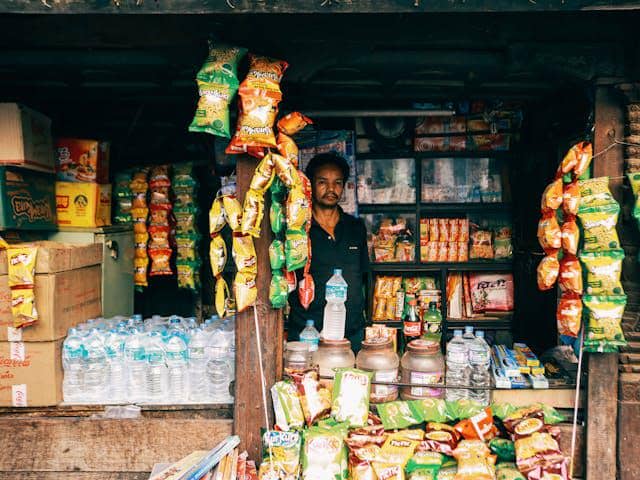
Ilustrasi toko jualan makanan dan minuman kemasan (pexels.com/Mehmet Turgut Kirkgoz)

• The government has formed 83,383 KDMPs (Village/Sub-district "Merah Putih" Cooperatives) as a national village-level economic network, backed by Rp34.57 trillion in Village Fund allocations, physical infrastructure development, bank financing, and the SIMKOPDES digital platform.

• The core challenge is not the number of cooperatives, but balancing uniform governance with business models that adapt to each village's economic potential, commodities, infrastructure, and purchasing power.

• Economic activation lags behind institutional formation: only 1,061 units were operational as of June 2026, with transaction activity concentrated in regions whose local economic ecosystems are relatively more prepared.

This section summary was AI-assisted and reviewed by our editorial team.

The Indonesian government is building more than 80,000 Village/Sub-district "Merah Putih" Cooperatives (Koperasi Desa/Kelurahan Merah Putih, KDMP) as a single national economic network. But the market they must serve is not a single market.

That tension is where this report's central question originates:

The challenge of giving 80,000 cooperatives the same governance standards without disregarding the economic differences across regions.

A nationwide network demands uniformity in governance, reporting, accounting, oversight, and access to financing. Economic relevance at the village level demands diversity in business models, product assortments, suppliers, and services. The real challenge is not how many cooperatives get established. It is designing a governance architecture capable of preserving local economic relevance at national scale.

The Big Bet

Presidential Instruction No. 9 of 2025 on Accelerating the Establishment of Village/Sub-district "Merah Putih" Cooperatives, issued by President Prabowo Subianto on 27 March 2025, orders the establishment of 80,000 cooperatives, addressed to 16 ministers and agency heads, all governors, and all regents and mayors. Its Second Directive sets out the scope of activities: cooperative offices, staple-goods procurement, savings and loans, village/sub-district clinics, village/sub-district pharmacies, cold storage/warehousing, and village/sub-district logistics.

Minister of Cooperatives Regulation No. 2 of 2025 on Business Development of Village/Sub-district "Merah Putih" Cooperatives, enacted by Minister of Cooperatives Ferry Joko Yuliantono on 9 September 2025, translates that instruction into a business model. Article 3(3) sets out seven business development objectives: meeting members' needs, raising members' income and welfare, growing competitive and innovative businesses, optimizing local economic potential, creating jobs, strengthening community self-reliance, and shortening supply chains to lower prices for consumers.

That formulation clarifies the ambition. The government is not building 80,000 savings-and-loan cooperatives. It is building a national economic network anchored at the village level, with cooperatives serving as the economic node at every point.

That ambition rests on three layers of infrastructure.

The fiscal layer. Minister of Finance Regulation No. 7 of 2026 on the Management of Village Funds for Fiscal Year 2026, effective since 12 February 2026, locks in 58.03 percent of the Village Fund to support KDMP implementation. According to Kompas.com, that allocation is worth Rp34.57 trillion out of a total 2026 Village Fund ceiling of Rp60.57 trillion, leaving around Rp25 trillion as the regular ceiling.

The physical layer. Article 15(3) of MoF Regulation 7/2026 directs the use of these funds toward installment payments for the physical construction of KDMP outlets, warehouses, and facilities. Beyond the Village Fund, the government has also pursued a bank-lending scheme. According to Jabar Publisher, Finance Minister Purbaya Yudhi Sadewa stated that the Ministry of Finance will repay roughly Rp40 trillion per year over six years in loans from Himbara (the state banks' association), including for the procurement of 105,000 operational pickup trucks.

The digital layer. Article 27 of Ministerial Regulation 2/2025 requires every cooperative to have and maintain a SIMKOPDES account, an integrated information system for recording institutional data, membership, business operations, and services, linked to systems run by other ministries and agencies.

The administrative mobilization has moved very quickly. Simkopdes data as of 29 June 2026 recorded 83,383 KDMP units formally established as legal entities. Of that number, 79,704 units had activated their accounts, 80,979 held a tax ID (NPWP), 60,762 held a business registration number (NIB), and 50,383 had held their Annual Member Meeting (RAT).

Establishing 83,383 legal entities in under fifteen months is a state-mobilization achievement that deserves recognition. But building a national economic network demands something different: making every node in that network genuinely function within its own market. The question becomes: what kind of governance architecture can manage a network this large without erasing the market differences it must serve?

80,000 Villages, Different Markets

Answering that question first requires understanding what Indonesia's village economy actually looks like. Here the data demands caution, because the answer depends on the resolution at which we observe it.

The 2024 Village Potential Survey (Podes) recorded 84,276 village-level administrative areas in Indonesia, comprising 75,753 villages (desa), 8,486 urban wards (kelurahan), and 37 special settlement/transmigration units (UPT/SPT), spread across 7,281 sub-districts and 514 regencies/cities. According to the Statistics of Village Potential in Indonesia 2024 publication, 66,002 villages/wards have populations mostly working in agriculture, forestry, and fisheries. Another 8,468 villages/wards rely mainly on wholesale and retail trade and vehicle repair, and 5,457 rely mainly on manufacturing.

At the aggregate level, this picture looks homogeneous — around 78 percent of Indonesian villages fall into the same single economic-sector category. The heterogeneity that matters for cooperative design sits one layer beneath that aggregate.

The "agriculture, forestry, and fisheries" category lumps together rain-fed rice villages, smallholder oil-palm villages, capture-fishing villages, pond-aquaculture villages, and social-forestry villages. All five sit in the same national statistical column, yet the cooperative business models they need are entirely different. Rice-growing villages need grain aggregation and fertilizer access. Fishing villages need ice and cold chains. Plantation villages need post-harvest processing. None of the three can be served by a staple-goods outlet with an identical layout and product assortment.

The second differentiating layer is the presence of a commercial commodity. Podes 2024 recorded only 23,300 villages/wards, or about 28 percent, with a designated flagship product. That means roughly 61,000 villages are entering this program without a clear anchor commodity for their cooperative to aggregate or market. For cooperatives in these villages, the offtaker function the government expects them to perform does not yet have a clear object to act on.

The third layer is geographic and infrastructural. BPS (Statistics Indonesia) uses the Geographic Difficulty Index (IKG) as one basis for Village Fund disbursement, and this index offers a quantitative proxy for measuring access differences between villages. Podes 2024 recorded 67,050 villages/wards with a river, 36,685 with an irrigation channel, and 10,857 with a small reservoir (embung). This uneven distribution determines whether a cooperative's logistics or warehousing unit is economically viable in a given location.

The fourth layer is purchasing power. The consumption patterns of peri-urban villages in Java differ from those of remote villages in eastern Indonesia, producing different basket sizes, purchase frequencies, and credit eligibility profiles.

The accurate framing, then, is this: a single national category can contain many different local market realities. Homogeneous on the surface, heterogeneous underneath.

The framework below summarizes hypothesized dominant needs by type of local economy. This table is an IDN Research Institute analytical framework, functioning as a working hypothesis that needs to be tested against unit-level Simkopdes data. It is not derived from empirical fieldwork.

Local economic type

Likely dominant needs

Agriculture

Farm inputs, fertilizer, financing, harvest aggregation

Fisheries

Ice, cold chain, storage, logistics

Tourism

Lodging, food and beverage, souvenirs, payments

Plantation

Aggregation, processing, distribution

Peri-urban

FMCG, daily necessities, digital services

Remote

Essential goods, healthcare, financial access

One Framework, Many Economies

This is where a close reading of the regulations produces a finding that runs against common assumption, and this is where the core of the issue lies.

The KDMP legal framework already provides ample room for localization.

Article 4(1) of Ministerial Regulation 2/2025 states that a cooperative may develop one or more business units from among seven available types. The regulation does not require every cooperative to run all seven. Paragraph (2) affirms that business-unit development must take into account each village's characteristics, potential, and existing economic institutions. Paragraph (3) opens room for other lines of business based on local wisdom, local community needs, and regional characteristics.

Article 6 requires mapping of business potential through identification of natural and human resources, economic potential based on local advantages, and the needs of members and the community. Article 7 requires the cooperative's management board to prepare a business development plan based on that mapping for each business unit, have it ratified at a Member Meeting, and then upload it to SIMKOPDES. Presidential Instruction 9/2025 itself, in its Second Directive, describes the scope of cooperative activities as "including but not limited to" those seven units.

Normatively, this design already answers the demand for localization. Describing KDMP as an institution with an identical model for every cooperative simply because of its regulations would be a misreading of the text.

The real problem emerges once we map two needs that run in parallel.

Why 80,000 Cooperatives Need Standardization

Why 80,000 Cooperatives Need Localization

Having a clear governance structure

Following local economic potential

Being supervisable and auditable

Understanding local community needs

Having accounting and reporting standards

Choosing a relevant business model

Being able to access financing

Determining products and assortment

Being digitally integrated

Building relationships with local producers

Being accountable to the state and to members

Responding to local market conditions

Both columns are equally valid. They also pull against each other.

The architecture currently surrounding cooperatives leans toward the left column. MoF Regulation 7/2026 channels Rp34.57 trillion of Village Fund into one very specific type of spending: installment payments for the physical construction of KDMP outlets, warehouses, and facilities. The procurement of 105,000 pickup trucks is carried out centrally and uniformly. Article 9(3) of Ministerial Regulation 2/2025 requires a cooperative to have an account and keep its SIMKOPDES information up to date before a financing application can be approved. Article 25(2) states that partnership facilitation is only provided once a cooperative has completed its profile on that same platform.

The resulting incentive structure is clear. Cooperatives that pursue standard physical assets and standard data completeness move faster toward financing and partnerships. Cooperatives that choose a distinctive business model suited to their local potential carry a heavier burden of proof, without an equivalent financing pathway.

The question, then, is no longer whether KDMP permits local adaptation. The regulations do permit it. The question is whether the fiscal, digital, financing, capability, and monitoring architecture surrounding these cooperatives is flexible enough to support the adaptation the law has already opened up.

The Governance Gap

This section tests that question against the available data, across four conditions: governance, capability, data, and economic activation.

Governance requirement

Chapter IV of Ministerial Regulation 2/2025 sets out a tiered reporting flow. The management board reports business progress to the regent/mayor every three months via SIMKOPDES, the regent/mayor reports to the governor, and the governor reports to the Minister with copies to relevant ministries. On paper, the framework is complete. The Ministry of Cooperatives' own strategic plan acknowledges that its monitoring data system is not yet optimal or fully integrated.

This flow is designed for uniformity. The unanswered question is whether a single reporting format can actually capture the differences in business models across cooperatives, or whether it instead flattens them into one template.

Capability requirement

This is where the gap between design and implementation is most visible — and it is a direct consequence of the localization the regulations themselves allow.

Ministerial Regulation 2/2025 sets minimum criteria for each business unit that are far from trivial. A village clinic needs at least two health workers and two health cadres (Article 17). A village pharmacy needs a pharmacist or vocational pharmacy staff (Article 18). Warehousing and cold storage need temperature and humidity control and separation of chemical goods from food products (Article 20). A logistics unit needs a transport fleet and trained personnel (Article 21). Article 12 requires every business unit to have an operational officer competent in its field.

The more a cooperative localizes its business model, the more specific the competencies it needs. A cooperative in a fishing village running cold storage requires an entirely different skill set than a peri-urban cooperative running a staple-goods outlet and payment services.

A village cooperative's management board typically has three to five members. According to Beritasatu, the Ministry of Cooperatives is preparing training and mentoring for around 35,000 prospective managers — a figure covering fewer than half of the units already established as legal entities. Nationwide training programs tend to be standardized, while the competencies actually needed are differentiated by local business model.

Institutional scale and economic activation

The two indicators below measure different things, and distinguishing between them matters for reading this program fairly.

83,383 legal entities show institutional scale. 1,061 operating units show economic activation.

The two indicators below measure different things, and distinguishing between them matters for reading this program fairly.

83,383 legal entities show institutional scale. 3,300 optimally operating units show economic activation.

According to CNN Indonesia, as of 8 June 2026 only 1,061 KDMP units were operating, all concentrated in two provinces: 530 units in East Java and 531 units in Central Java. In his State Address to the House of Representatives (DPR) on 14 August 2026, President Prabowo Subianto stated that 3,300 KDMPs were operating optimally. Against the 83,383 units established as legal entities, that figure amounts to roughly four percent.

Physical construction has moved far faster than activation. According to Kompas.com, Minister of Cooperatives Ferry Juliantono stated on 25 August 2026 that 21,400 units were 100 percent complete as of 20 August 2026 — covering warehouses, outlets, and supporting facilities — while another 13,900 units were still under construction. The two figures together total nearly 35,300 units.

Databoks reports, drawing on Simkopdes data trackable via https://simkopdes.go.id/pers/dashboard, that KDMP transaction value stood at Rp29.58 billion as of 29 June 2026. That figure should be read as a snapshot of an early phase, and the period it covers is not explicitly stated in the source.

The operational target has already been revised downward twice. According to Bisnis.com, in a working meeting with House Commission VI on 11 June 2026, Ferry Juliantono stated that the 2026 operational target had been cut from 80,000 to a maximum of 40,000 units. In his 14 August 2026 address, the President set a target of 30,000 units established and operating by year's end. According to the Coordinating Ministry for Food Affairs, Coordinating Minister for Food Affairs Zulkifli Hasan, on the same date, targeted that cooperatives with completed construction would begin operating by September 2026. This repeated revision marks a shift in focus — from mass institutional formation toward strengthening operational quality.

Where Activation Happens First

An analysis published by The Conversation Indonesia on 19 June 2026, combining Simkopdes data as of 2 June 2026 with 2025 BPS poverty data across 484 regencies/cities, found a significant negative correlation between regional poverty levels and cooperative transaction activity. Of 34 regencies with poverty rates above 25 percent, 33 recorded not a single transaction. The provincial pattern points the same way: 34.8 percent of KDMPs in Banten, 25 percent in Jakarta, and 24 percent in Central Java and East Java had already recorded transactions, while Papua, Maluku, and several other provinces outside Java recorded none.

This finding is correlational and does not establish causal direction. What can safely be concluded is that cooperative activity so far has emerged more in regions whose local economic ecosystems appear better prepared to sustain cooperative operations.

The distribution of units clarifies why this matters. Papua Pegunungan ranks tenth nationally with 2,387 units — more than most provinces outside the top five. Institutional presence there is high, while economic activity has yet to be recorded.

Source: IDN Research Institute processing of Simkopdes data as of 29 June 2026.

Rank

Province

Number of units

1

Central Java

8,524

2

East Java

8,494

3

Aceh

6,534

4

North Sumatra

6,102

5

West Java

5,971

6

East Nusa Tenggara

3,452

7

South Sumatra

3,267

8

South Sulawesi

3,081

9

Lampung

2,651

10

Papua Pegunungan

2,387

Central Java shows what relatively mature readiness looks like. Of the 8,524 units in that province, 8,523 already hold a tax ID and 8,150 hold a business registration number, with physical outlet construction reaching 85.53 percent. The province also accounts for half of all cooperatives operating nationwide as of June 2026.

This pattern reshapes the policy question. If the most difficult markets are also the hardest places to get a cooperative genuinely operating, what governance and capability model is needed to make this program work precisely in the regions that need such an economic node the most?

From Cooperative to Market Infrastructure

The government is directing cooperatives to become distribution nodes for state programs. According to Kompas.com, Zulkifli Hasan stated that Family Hope Program (PKH) assistance, farm-equipment aid, subsidized fertilizer, and subsidized gas will be channeled through cooperatives, along with electricity and telephone bill payment services. Cooperatives are also projected to act as offtakers for local agricultural and fishery output.

Reading this as 80,000 new distribution points is the easiest strategic mistake to make.

80,000 KDMPs do not mean 80,000 identical outlets. If each cooperative's business model adapts to its local economy, then what a company actually faces is 80,000 potential nodes with different economic functions.

The strategic question therefore shifts. The old question was: how do we distribute our products to 80,000 cooperatives? The more useful question is: which cooperatives matter for which category, and why?

Source: Ministerial Regulation No. 2/2025

Node economic character

Relevant category

Regulatory basis (Ministerial Regulation 2/2025)

Agricultural cluster

Farm inputs, financing, harvest aggregation

Articles 20 and 21

Fisheries cluster

Ice, cold chain, storage, logistics

Articles 20 and 21

Tourism node

Food and beverage, souvenirs, payment services

Article 4(3)

Peri-urban

FMCG, daily necessities, digital services

Article 16 and Article 14(3)

Remote

Essential goods, healthcare, financial access

Articles 16, 17, 18, and 22

This mapping of economic character to business unit is an IDN Research Institute analytical framework. Ministerial Regulation 2/2025 governs the function of each business unit without mapping it to village economic type.

This category fit determines which slice of the 83,383 units is relevant to a given company, and which slice is not relevant at all.

Two provisions determine a realistic way in.

SIMKOPDES functions as the partnership gateway. Article 25(2) states that partnership facilitation is only provided once a cooperative has completed its profile on the platform. A cooperative's data status is therefore an indicator of partnership readiness that can be checked before any field approach is made.

Secondary cooperatives could serve as an aggregation layer. Article 26 opens the way for forming secondary cooperatives among KDMPs within a single regency/city, as well as business networks based on shared commodities or supply chains. For large companies, the efficient unit of negotiation is likely to sit at this level. Interestingly, this layer is also a mechanism that lets cooperatives preserve local differentiation while still reaching a scale that is viable to partner with.

Article 24 broadens the range of eligible partners: other cooperatives, state-owned enterprises (BUMN), regional-owned enterprises (BUMD), village-owned enterprises (BUMDes), businesses from micro to large scale, community organizations, universities, ministries/agencies, and local governments. Article 30 states that the Ministry sets the business scheme for application-system providers, or tech providers, working with cooperatives.

A Strategy for Entering the Rural Market

The emergence of KDMP does not mean the creation of 80,000 distribution points with identical characteristics. This network instead has the potential to open access to an extremely diverse rural market, with different consumer needs, commodities, purchasing power, infrastructure, and levels of operational readiness.

For that reason, an entry strategy through KDMP cannot simply start from the question "how do we reach as many cooperatives as possible?" The more strategic question is: which cooperatives are relevant to a given category, what needs do they serve, and how far does the business model need to be adapted to serve each group?

This is where the tension between scale efficiency and local relevance arises.

The Localization Premium

In this report, we use the term Localization Premium to describe the additional complexity, capability, and cost that arise when a market strategy needs to be adapted to local characteristics. This term is an analytical framework we introduce in this report, not an established academic term.

A highly standardized strategy allows for a relatively uniform product assortment, pricing architecture, distribution model, training materials, and monitoring system. Its advantage is operational efficiency and scale.

But the same strategy is not necessarily relevant across the entire rural market. A cooperative operating in an agricultural area may have needs different from one in a fisheries area. A cooperative in a peri-urban zone may face a different demand profile than one in a remote area. These differences can require adjustments to products, suppliers, logistics, labor, financing, and partnership patterns.

These adjustments create the Localization Premium: the further a market's needs diverge from the standard model, the greater the resources required to keep the offering relevant.

That premium is not always a burden, however. Localization becomes worthwhile when the added relevance it produces generates an economic opportunity greater than the cost and complexity of achieving it.

The issue, then, is not whether the entire KDMP network needs to be localized. The issue is where localization is needed, how much localization is needed, and in which segments that investment is economically worthwhile.

A Five-Step Segmentation Framework

The number of cooperatives shows network scale, but not yet the commercial value or relevance of each unit to a given category. The framework below shifts the basis of a market-entry strategy from cooperative headcount toward clusters of economic characteristics:

Step 1. Operational readiness. Sort units into four tiers: already operating (1,061 as of June 2026), physically complete and awaiting a manager (15,845 as of July 2026), under construction (19,539), and holding legal-entity status only. More than half of all units nationwide fall into this last category.

Step 2. Local economic engine. Use the Podes classification to separate agriculture, fisheries, plantation, tourism, manufacturing, peri-urban, and remote clusters, then check for the presence of a flagship product.

Step 3. Consumer economics. Use regency-level poverty and purchasing-power data to determine basket size, purchase frequency, and the viability of a credit model.

Step 4. Geographic and infrastructure conditions. Consider geographic and infrastructure conditions, including the IKG, road access, storage facilities, and digital connectivity. These factors determine not just whether a market can be reached, but also how much it costs to serve it sustainably.

Step 5. Category fit. Once regional characteristics and cooperative readiness have been mapped, determine which product or service category has the strongest market fit for each cluster. Not every cooperative is a relevant target for every category.

With this approach, the figure of 83,383 is no longer the final measure of market opportunity. It becomes the starting point for identifying clusters of cooperatives with different economic characteristics, operational readiness, and market needs.

The strategic question then shifts from "how do we get into 83,383 cooperatives?" to "which clusters are worth serving, what proposition is relevant for each cluster, and how much Localization Premium is worth bearing to serve that market?"
Policy Implications

  • Measure economic activation, not institutional completion. Explicitly distinguish four different statuses: established, ready, operating, and economically viable. Counts of legal entities, NIBs, and Annual Member Meetings measure administrative mobilization and cannot substitute for indicators of actual business activity.

  • Align financing mechanisms with the localization the regulations already permit. As long as the Village Fund is directed toward uniform physical assets, the business-model flexibility written into Article 4 of Ministerial Regulation 2/2025 will be difficult to realize on the ground.

  • Build capability at the points of highest complexity. Training spread evenly across all units is less effective than training prioritized by business-model complexity — such as cold storage, pharmacy, clinic, and logistics units in areas with a high Geographic Difficulty Index.

References

Badan Pusat Statistik. (2025). Statistik potensi desa Indonesia 2024. Badan Pusat Statistik.

Beritasatu. (2026, 15 Juni). Kemenkop targetkan 30.000 Kopdes Merah Putih beroperasi Agustus 2026. Retrieved 28 August 2026, from https://www.beritasatu.com/ekonomi/3002768/kemenkop-targetkan-30000-kopdes-merah-putih-beroperasi-agustus-2026

Bisnis.com. (2026, 12 Juni). Kemenkop pangkas 50% target operasional KopDes di tahun ini, jadi 40.000. Retrieved 28 August 2026, from https://ekonomi.bisnis.com/read/20260612/12/1980623/kemenkop-pangkas-50-target-operasional-kopdes-di-tahun-ini-jadi-40000

CNN Indonesia. (2026, 11 Juni). 12 ribu gerai Kopdes Merah Putih rampung, 1.061 sudah beroperasi. Retrieved 28 August 2026, from https://www.cnnindonesia.com/ekonomi/20260611123103-92-1367861/12-ribu-gerai-kopdes-merah-putih-rampung-1061-sudah-beroperasi

Databoks. (2026, 29 Juni). Barang dengan nilai transaksi tertinggi di Kopdes Merah Putih Juni 2026. Retrieved 28 August 2026, from https://databoks.katadata.co.id/produk-konsumen/statistik/6a424e9bcb1cc/barang-dengan-nilai-transaksi-tertinggi-di-kopdes-merah-putih-juni-2026

Instruksi Presiden Republik Indonesia Nomor 9 Tahun 2025 tentang Percepatan Pembentukan Koperasi Desa/Kelurahan Merah Putih. (2025).

Kompas.com. (2026, 15 Februari). 58 persen Dana Desa 2026 diwajibkan untuk Koperasi Merah Putih. Retrieved 28 August 2026, from https://money.kompas.com/read/2026/02/15/154443026/58-persen-dana-desa-2026-diwajibkan-untuk-koperasi-merah-putih

Kompas.com. (2026, 5 Juli). Target Kopdes Merah Putih dipangkas jadi 40.000 unit, mulai beroperasi Oktober. Retrieved 28 August 2026, from https://money.kompas.com/read/2026/07/05/061500226/target-kopdes-merah-putih-dipangkas-jadi-40.000-unit-mulai-beroperasi-oktober

Kompas.com. (2026, 12 Juli). Pemerintah kebut Kopdes Merah Putih, 35.000 ditargetkan beroperasi Agustus 2026. Retrieved 28 August 2026, from https://money.kompas.com/read/2026/07/12/180000126/pemerintah-kebut-kopdes-merah-putih-35.000-ditargetkan-beroperasi-agustus-2026

Peraturan Menteri Keuangan Republik Indonesia Nomor 7 Tahun 2026 tentang Pengelolaan Dana Desa Tahun Anggaran 2026. (2026).

Peraturan Menteri Koperasi Republik Indonesia Nomor 2 Tahun 2025 tentang Pengembangan Usaha Koperasi Desa/Kelurahan Merah Putih. (2025). Berita Negara Republik Indonesia Tahun 2025 Nomor 694.

The Conversation Indonesia. (2026, 19 Juni). Alih-alih terserap, Rp3 miliar untuk 40 ribu Koperasi Desa Merah Putih malah akan banyak menguap. Retrieved 28 August 2026, from https://theconversation.com/alih-alih-terserap-rp3-miliar-untuk-40-ribu-koperasi-desa-merah-putih-malah-akan-banyak-menguap-284732

Curated For You

Editorial Team

Related Article