Indonesia Labor Market 2026: Formal Jobs Are Declining
- Jumlah pekerja Indonesia naik jadi 147,67 juta pada Februari 2026, tapi mayoritas pertumbuhan terjadi di sektor informal yang kini mencakup hampir 60% tenaga kerja nasional.
- Tingkat pengangguran terbuka turun ke 4,68%, namun pengangguran muda justru meningkat ke 16,36%, menandakan tantangan besar bagi generasi baru memasuki pasar kerja formal.
- Pemerintah disarankan memperkuat jaminan sosial bagi pekerja informal, memperluas indikator keberhasilan pasar kerja, dan menyelaraskan pendidikan vokasi dengan kebutuhan industri.
As of February 2026, 147.67 million Indonesians were employed. This figure increased by nearly two million people compared with the previous year. However, many of the new jobs created have strengthened the informal sector, where workers generally lack permanent employment contracts, employer-based benefits, and the same level of social protection as formal workers.
This is the story behind the National Labor Force Survey, or Sakernas, released by Statistics Indonesia, BPS, on May 5, 2026. Unemployment has declined and the number of employed people has increased. Yet beneath those improvements, the structure of Indonesia’s labor market is moving in a direction that deserves closer attention.
The Numbers That Look Good
Indonesia’s open unemployment rate stood at 4.68 percent in February 2026. This was down by 0.08 percentage points compared with February 2025. The number of unemployed people also fell by around 35,000.
The underemployment rate, which refers to people working fewer than 35 hours per week while still seeking additional work, also declined significantly from 8.00 percent to 7.27 percent.
From the headline numbers alone, Indonesia’s labor market appears to be improving.
But another set of numbers is moving in the opposite direction.
What the Headline Does Not Show
Of Indonesia’s 147.67 million workers, only 59.93 million people, or 40.58 percent, were employed in the formal sector. This share declined by 0.02 percentage points compared with February 2025.
At first glance, the decline looks small. But in absolute terms, the story becomes more significant.
The number of formal workers did increase by around 736,000 compared with the previous year. However, the number of informal workers increased by more than 1.16 million over the same period. This means that, out of every three new workers entering Indonesia’s labor market, around two entered the informal sector.
This is not the first time the pattern has appeared. In February 2024, formal workers accounted for 40.83 percent of total employment. The share declined to 40.60 percent in February 2025, then fell again to 40.58 percent in 2026. The trend is consistent, and the direction is downward.
Who Counts as an Informal Worker?
Under BPS classification, formal workers include employees, wage workers, and those who run businesses with permanent or paid workers. Outside these categories, workers such as the self-employed, those running businesses assisted by temporary or unpaid workers, casual workers, and unpaid family workers are classified as informal workers.
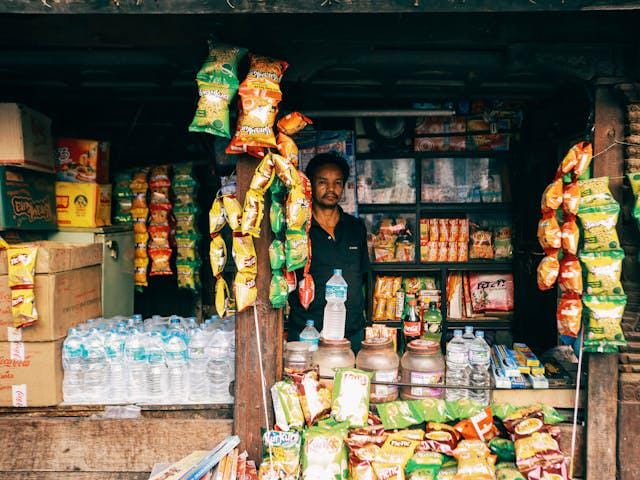
This group includes tenant farmers, small market traders, casual agricultural workers, digital platform partners who are not classified as employees, domestic workers, and millions of others.
Agriculture, forestry, and fisheries remain Indonesia’s largest employment sector, absorbing 42.49 million workers, or 28.78 percent of the national workforce. Most workers in this sector are informally employed.
Wholesale and retail trade follows with 26.51 million workers, or 17.95 percent of the national workforce. This sector is also dominated by self-employment and small traders.
Of course, not all informal workers live in hardship. Some choose flexibility, while others earn a decent income. However, many workers are in the informal sector not by choice, but because of limited access to formal employment. That is where the problem begins.
Social Protection Is Falling Behind
This is where informality becomes a real issue.
Formal workers generally have access to employment social security, workplace accident protection, retirement benefits, and severance pay when their employment relationship ends.
Informal workers can register independently for BPJS Ketenagakerjaan, Indonesia’s employment social security program. However, participation remains low due to limited information, cost barriers, and the difficulty of maintaining regular contribution payments.
The average wage for employees in February 2026 was Rp3.29 million per month, up from Rp3.09 million a year earlier. However, this figure refers to the average wage of employees, wage workers, and salaried workers, meaning it does not fully reflect the income of informal workers, self-employed workers, or unpaid family workers.
By sector, the lowest average wage was recorded in arts, other services, household activities, and international organization activities, at Rp2.00 million per month. In contrast, the financial and insurance sector recorded an average wage of Rp5.05 million.
The gap of more than Rp3.05 million per month between the lowest- and highest-paying sectors is not only about income. It also reflects long-term differences in quality of life and access to economic protection.
Young People Are Entering the Labor Market, but Where Are They Landing?
One figure deserves particular attention.
The unemployment rate among young people aged 15 to 24 increased from 16.16 percent in February 2025 to 16.36 percent in February 2026.
While the 25 to 59 age group saw its unemployment rate decline by 0.11 percentage points, young people entering the labor market are finding it harder to secure work.
Those who do manage to enter the workforce are more likely to land in the informal sector, because this is the segment growing faster.
A 22-year-old fresh graduate working as a freelancer, online seller, or digital platform partner may be counted as “employed” in official statistics. However, that job does not automatically provide retirement protection, health benefits, or income certainty for the following month. They are working, but without security.
Three Things That Need to Change
This data is not yet an emergency alarm. But it points to three policy priorities that deserve serious attention.
First, the government needs to redesign social security models for informal workers. More flexible contribution schemes based on daily or weekly income, rather than monthly payments, should be considered so that the system better reflects the irregular income patterns of informal workers.
Second, the way labor market success is measured needs to be broadened. A falling unemployment rate can hide structural problems if it is not read alongside data on employment formality and real wages. An unemployment rate of 4.68 percent cannot be fully understood without considering that 59.42 percent of Indonesia’s workforce is still in the informal sector.
Third, vocational education needs to become more aligned with the needs of the formal labor market. Vocational high school graduates recorded the highest unemployment rate among all education levels, at 7.74 percent. This was higher than the unemployment rate among general senior high school graduates, at 6.23 percent. The data shows that the alignment between education curricula and industry demand still requires meaningful improvement.
The Paradox Indonesia Needs to Answer
Indonesia’s labor market in 2026 cannot be read in only one color.
On one hand, there are clear signs of improvement. More people are working, open unemployment has declined, and underemployment has fallen significantly.
On the other hand, a less reassuring trend is also emerging. Informality continues to erode the share of formal employment, young people are finding it harder to enter the labor market, and the female labor force participation rate has declined by 0.29 percentage points.
Behind the headline figure of 147.67 million workers, there are 87.74 million people working in the informal sector, a group that generally has more limited access to labor protection and social security. They account for nearly 60 percent of Indonesia’s entire workforce.
That is why the most important question is not only “how many people are working,” but also “under what conditions are they working?”
Source: Statistics Indonesia, BPS, Official Statistics Release No. 49/05/Th. XXIX, May 5, 2026, Indonesia Labor Force Situation February 2026.